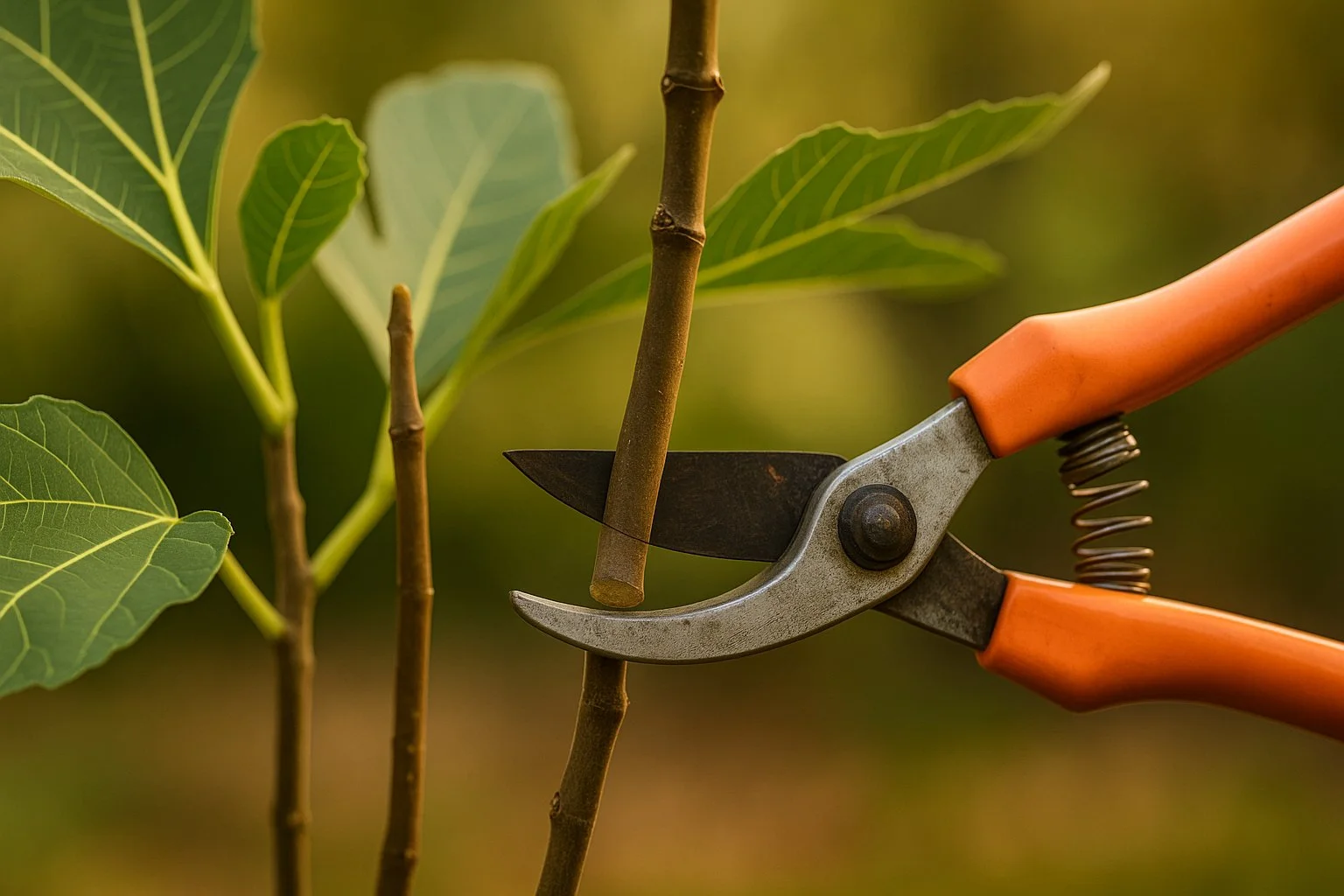
How to Prune Fig Trees: Beginner-Friendly Step-by-Step Guide (Zone 7b)

Beginner Guide pruning fig trees in Zone 7b
This is a simple, beginner-friendly overview of pruning fig trees in Zone 7b.
For the full professional pruning system—covering structure, seasonal timing, height control, and orchard-level methods—read our pillar guide Pruning & Training for Maximum Growth and Productivity.
Pruning is one of the most important skills a fig grower can learn, yet it is also one of the most misunderstood. Many new growers are hesitant to prune because they fear damaging the tree, while others prune too aggressively without understanding how figs actually produce fruit. When done correctly, pruning strengthens the structure of the tree, balances growth and fruiting, improves air circulation, and dramatically increases both the quantity and quality of your figs.
To understand pruning, it helps to first understand how figs bear fruit. Most common figs produce their main crop on new growth—shoots that emerge during the current season. This means that vigorous, healthy new branches are the engine of production. Older wood supports the tree, but it is the fresh shoots that will carry the bulk of the figs. A small number of varieties (such as Celeste) produce a small breba crop on last year’s wood, but in Zone 7b this crop is often less reliable due to winter injury. As a result, the best pruning systems focus on encouraging abundant new growth each year while maintaining a stable, open framework that supports the tree through weather variations and harvesting.
There are two primary training styles for figs: the multi-stem bush form and the single-trunk tree form. Both can be highly productive, and the choice largely depends on climate and grower preference. In Zone 7b, the bush form is the most popular because it is naturally suited to winter protection. Multiple trunks allow the tree to regrow quickly after rare cold events and make it easier to bend or wrap the tree for winter. The tree form, with a single main trunk and a canopy above, offers a clean, orchard-like appearance and is ideal for growers who prefer taller trees with easier access beneath the canopy. Either form can produce excellent results with proper pruning.
Pruning begins in late winter or early spring, just before new growth emerges. This timing allows you to clearly see the framework of the tree and remove anything that was damaged during winter. Start by identifying any dead or winter-killed branches; these will appear dry, brittle, and gray inside when cut. Removing this dead wood prevents disease and stimulates healthy new shoots. Next, remove weak or crossing branches that crowd the center of the tree. Figs benefit from an open structure that allows sunlight to reach the interior, which promotes even ripening and reduces the risk of fungal problems during humid southern summers.
With the tree cleaned up, the next step is shaping its overall structure. In a bush form, this means selecting three to five strong trunks or primary branches and removing additional suckers at the base. Leaving too many trunks results in a congested plant that wastes energy on unproductive wood. By contrast, a healthier, more controlled bush responds with vigorous new shoots each spring. In a tree form, shaping involves maintaining a single trunk and selecting a set of well-spaced scaffold branches to create an open canopy. Figs respond exceptionally well to directional pruning, so cuts made above an outward-facing bud encourage growth that spreads the tree wide rather than tight and upright.
Summer pruning is an optional but powerful tool for maximizing fruit quality. Because figs set fruit on new growth, lightly tipping excessively long shoots (removing just an inch or two) can stimulate branching that leads to more fruiting sites. However, this technique should be used with moderation; heavy summer pruning can delay ripening. In very vigorous varieties or in rich soil, summer pruning helps balance the tree’s growth and keeps fruiting branches within reach.
Container-grown figs benefit from yearly pruning to maintain their size and shape. Their restricted root space means they cannot support the sprawling growth of an in-ground tree, so pruning helps them remain productive without becoming unwieldy. Reducing the canopy by one-third during winter is a common approach, encouraging a flush of new growth each spring.
No matter the training system, good pruning must be paired with fruit thinning when necessary. If a branch sets more figs than it can support, the fruit will remain small and may not ripen evenly. Removing a few early in the season allows the remaining figs to size and sweeten properly. This is especially helpful in younger trees and in varieties prone to heavy fruit set.
Over time, a well-pruned fig tree becomes far more productive than one left untouched. The tree develops a strong framework, produces fruit throughout the canopy rather than at the tips, and remains easier to harvest and maintain. In Zone 7b, where winter conditions may influence growth patterns from year to year, pruning also helps reset the structure and remove older wood that no longer contributes effectively to fruiting.
Figs respond generously to good pruning. Once you understand how fruiting wood develops and how to guide your tree’s structure, pruning becomes not a chore but an essential tool for directing the tree’s energy toward abundant, high-quality fruit. With this skill in hand, your fig tree will reward you with consistent harvests and strong, balanced growth for decades.
Want the full pruning system used in our Zone 7b orchard?
Learn the complete approach—structure, seasonal pruning, managing height, breba vs. main crop balance, and orchard scaling—in our pillar article Pruning & Training for Maximum Growth and Productivity.