Borers and Trunk Damage: What’s Serious and What’s Not
Introduction
Damage to the trunk or major branches of a fig tree often causes immediate alarm. Holes in the bark, oozing sap, roughened areas, or dead sections of wood are easily interpreted as signs of a serious pest infestation. Among the most feared possibilities are borers, insects whose larvae tunnel into woody tissue. In Zone 7b, where figs experience both rapid summer growth and periodic winter injury, trunk damage is common and frequently misunderstood.
This article provides perspective. Its goal is to help growers distinguish between cosmetic or recoverable trunk damage and situations that truly threaten the structure or survival of a fig tree. Understanding what borers do, when they matter, and when trunk damage can be safely ignored prevents unnecessary panic and helps growers respond appropriately.
Why Trunk Damage Looks Worse Than It Is
The trunk represents permanence and stability, so any visible injury naturally feels serious. However, fig trees possess an unusual capacity to compartmentalize damage. They routinely seal off injured tissue, redirect growth, and rebuild structure from healthy wood. Because figs are not dependent on a single trunk or rigid form, damage that would cripple other fruit trees is often survivable for figs.
In Zone 7b, trunk damage frequently results from environmental stress rather than insects alone. Cold injury, sunscald, mechanical damage, and pruning wounds all create visual symptoms that resemble borer activity. Recognizing this overlap is the first step toward calm diagnosis.
What Is a Fig Tree Borer?
Borers are the larval stage of certain beetles or moths that lay eggs on or near woody plants. When larvae hatch, they feed on inner bark or wood, creating tunnels as they grow. In figs, borers typically target stressed or weakened tissue rather than healthy, vigorous wood. They are opportunistic rather than aggressive.
This behavior is critical to understanding their role. Borers are often a consequence of damage rather than its primary cause. They exploit existing weaknesses rather than initiating decline.
Why Borers Target Fig Trees
Fig trees that experience stress are more attractive to borers. Stress may result from drought, root restriction, winter dieback, sunscald, or mechanical injury. In Zone 7b, freeze damage followed by warm spring temperatures can leave exposed or weakened wood that attracts egg-laying insects.
Healthy, actively growing figs are far less likely to suffer meaningful borer damage. This is why orchard context matters more than the presence of the insect itself.
Differentiating Borer Damage from Other Trunk Issues
Not all holes or scars indicate borers. Sap seepage, rough bark, and localized dieback may be caused by winter injury, sun exposure on newly revealed bark, or pruning cuts that healed unevenly. These issues often stabilize or improve over time as the tree produces new tissue.
True borer damage typically progresses slowly and is localized. It does not usually cause sudden collapse or rapid decline. Observing whether damage expands over seasons provides valuable insight.
How to Tell If Damage Is Serious
Fine sawdust at trunk base
Likely Cause: Active borer larva
Serious? Yes
What To Do: Remove larva and monitor trunk integrity
Fresh round trunk entry holes with frass
Likely Cause: Active fig trunk borer
Serious? Often
What To Do: Confirm internal tunneling before cutting; monitor for spread
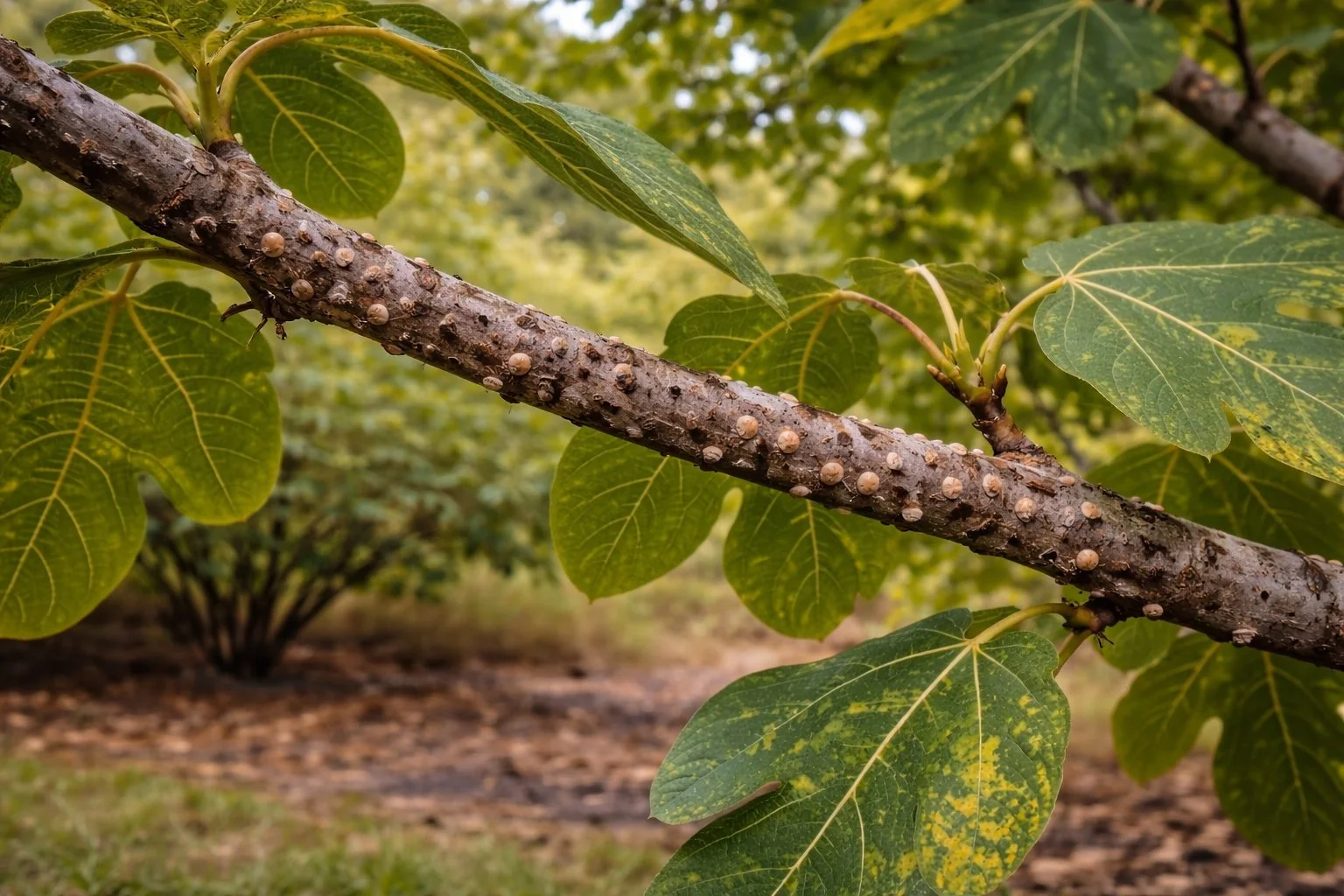
Smooth round bark bumps
Likely Cause: Lenticels (normal bark feature)
Serious? No
What To Do: No action needed
Shallow surface chewing
Likely Cause: Cosmetic insect feeding
Serious? Usually No
What To Do: Reduce stress and observe
Cosmetic Trunk Damage and Natural Healing
Fig trees frequently display scars, cracks, and rough patches that never affect performance. As figs grow, older bark sloughs off and new tissue forms, often obscuring past injuries. Cosmetic damage may remain visible but inactive for years without compromising tree health.
In Zone 7b, where figs are often grown as multi-stem bushes, even partial trunk loss does not necessarily reduce productivity. New shoots frequently compensate for damaged sections.
When Trunk Damage Becomes Functionally Important
Trunk damage becomes serious when it compromises vascular flow or structural integrity. This occurs when damage encircles a stem, progresses rapidly, or leads to widespread dieback above the affected area. In such cases, the tree may redirect growth below the injury or decline gradually if alternatives are unavailable.
Even then, figs often respond by sending up new shoots from the base or healthy wood, allowing growers to rebuild structure rather than losing the tree entirely.
The Role of Winter Injury in Zone 7b
Winter injury is a major contributor to trunk damage in Zone 7b. Freeze–thaw cycles can crack bark, kill cambium, or weaken wood, creating entry points for secondary organisms. Borers that appear after winter injury are often responding to dead or dying tissue rather than causing the original damage.
Understanding the timing of injury relative to insect appearance helps avoid misattribution and unnecessary treatment.
Stress Reduction as the Primary “Solution”
Because borers target stressed tissue, reducing stress is the most effective response. Improving soil moisture consistency, avoiding trunk sunscald, protecting trees during winter, and maintaining overall vigor reduce the likelihood of meaningful borer activity. These measures address the conditions that invite borers rather than focusing narrowly on the insects themselves.
In healthy orchards, borer presence often fades as trees recover strength.
The Myth of Immediate Intervention
Growers are often advised to take immediate action when borers are suspected. In practice, urgent intervention is rarely necessary for figs. Drilling, injecting, or aggressively cutting into trunks frequently causes more harm than benefit. Such actions enlarge wounds, increase stress, and disrupt natural compartmentalization.
Observation over time provides clearer guidance than immediate reaction.
Structural Pruning and Recovery
When trunk sections are clearly dead or nonfunctional, removal during appropriate pruning periods allows the tree to redirect energy into healthy growth. Fig trees tolerate structural adjustment well, especially when managed as multi-stem systems. In many cases, what appears to be severe trunk damage becomes an opportunity to improve long-term structure.
This adaptive capacity distinguishes figs from more rigid fruit trees.
When Borers Truly Matter
Borers warrant concern primarily when damage progresses steadily across seasons, when multiple major stems are affected simultaneously, or when trees fail to produce new growth despite favorable conditions. These situations suggest underlying stress that must be addressed at the orchard level.
Even then, the response should focus on improving growing conditions rather than attempting eradication.
Avoiding Overreaction and Preserving Balance
The greatest risk associated with borer fear is overreaction. Excessive cutting, unnecessary treatments, or repeated disturbance often weaken trees further. Balanced orchards recover more effectively when growers allow figs to express their natural resilience.
Confidence grows with experience and careful observation.
Long-Term Perspective on Trunk Damage
Most fig growers in Zone 7b observe some degree of trunk damage over the life of their trees. Trees adapt, regenerate, and continue producing. Trunk damage becomes part of the tree’s history rather than a defining limitation.
This long-term perspective transforms concern into understanding.
The Takeaway
Borers and trunk damage look serious but rarely threaten fig trees in Zone 7b. Most damage is cosmetic, secondary, or recoverable, especially in vigorous trees. By focusing on stress reduction, careful observation, and long-term structure rather than immediate intervention, growers protect their trees more effectively. Knowing what to worry about—and what to ignore—is the key to confident fig management.
This article is part of the complete guide to Pests & Diseases of Fig Trees in Zone 7b.
Frequently Asked Questions About Fig Tree Borers
Q: How do I know if my fig tree has borers?
The most reliable sign of active fig tree borers is fresh frass — a fine, sawdust-like material — collecting at the base of the trunk or around small, round entry holes. True borer damage involves internal tunneling rather than surface chewing. If you see expanding holes with debris present, inspection is warranted. Cosmetic bark texture alone is not evidence of infestation.
Q: Can a fig tree survive borer damage?
In many cases, yes. Fig trees are resilient and often compartmentalize localized trunk damage. If the infestation is limited and the structural wood remains intact, the tree may recover fully once stress is reduced. Severe girdling or widespread tunneling, however, can compromise long-term stability.
Q: What does borer frass look like on a fig tree?
Borer frass appears as fine, dry, sawdust-like debris. It may accumulate at the base of the trunk or cling to bark near entry holes. Unlike wet sap leakage, frass is granular and often indicates active larval feeding within the wood.
Q: When should I remove a damaged fig trunk?
Removal becomes appropriate when trunk damage compromises structural integrity or interrupts vascular flow. If the damaged section is unstable, deeply tunneled, or declining season after season, pruning back to healthy wood is advisable. In multi-stem figs common to Zone 7b, replacing one trunk does not necessarily reduce overall productivity.
