Best Irrigation Setup for Fig Orchards
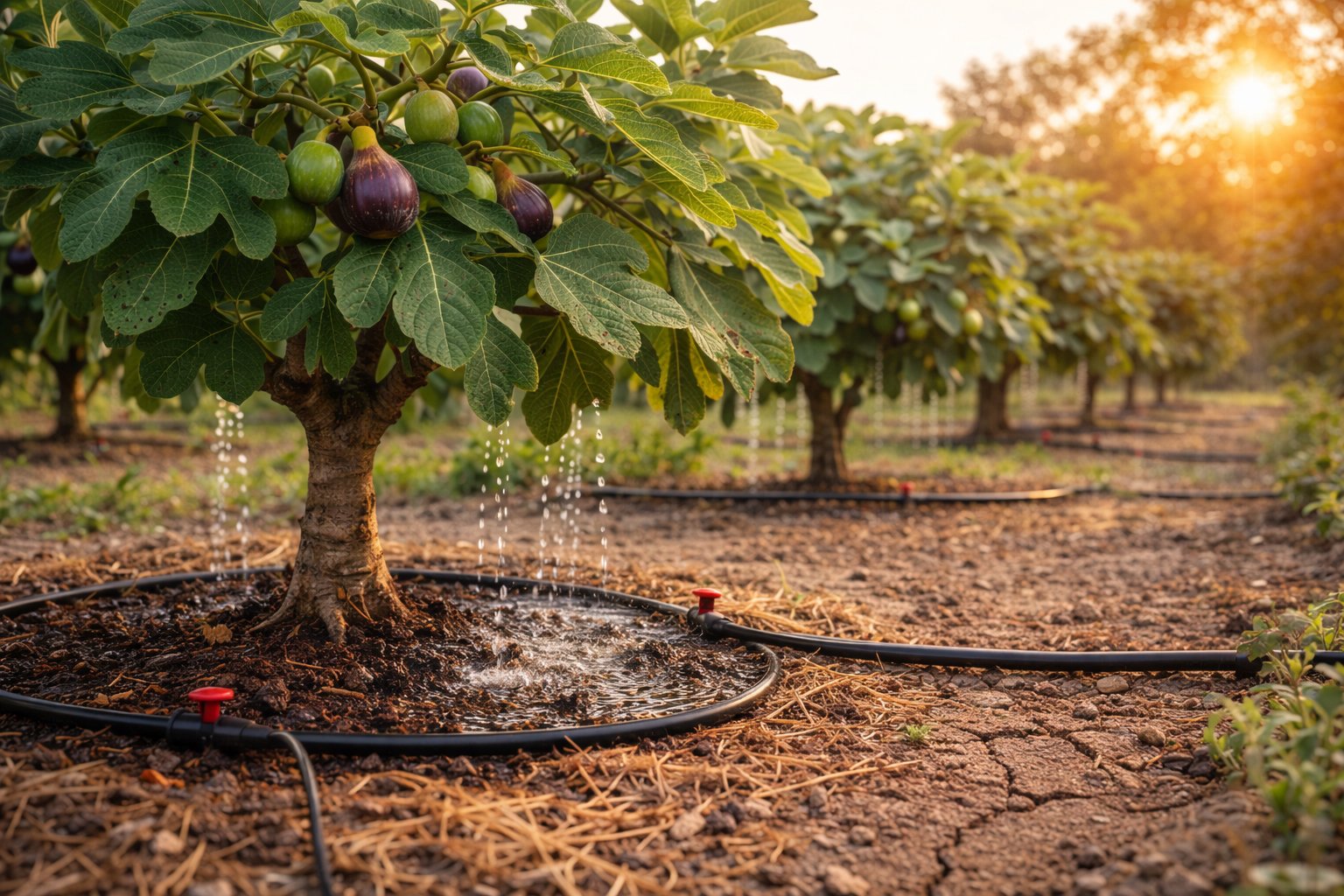
Designing an irrigation system for a fig orchard is not about maximizing water delivery, but about controlling it. Figs thrive when water is applied intentionally and consistently, supporting steady growth without saturating the root zone. A well-designed irrigation setup simplifies management, protects soil structure, and allows growers to scale watering practices as plantings expand.
Unlike hand watering, which varies with time and attention, an irrigation system creates predictability. That predictability is essential in orchards, where uniform water delivery ensures that each tree develops under similar conditions, simplifying pruning, harvest timing, and long-term care.
Principles That Guide Effective Fig Irrigation
The most effective irrigation systems for figs apply water slowly, deeply, and evenly. Rapid water application encourages runoff and shallow wetting, while slow delivery allows moisture to infiltrate the root zone. Even distribution prevents some trees from receiving excess water while others remain stressed.
Equally important is flexibility. An irrigation system should adapt to seasonal changes, allowing reduced watering during cool or wet periods and increased delivery during heat and fruit development. Systems that cannot be adjusted easily often lead to chronic overwatering or underwatering.
Drip Irrigation: The Preferred Orchard System
Drip irrigation is the most reliable and controllable option for fig orchards. By delivering water directly to the root zone at a slow rate, drip systems minimize evaporation and reduce weed growth between rows. This targeted approach aligns well with figs’ preference for deep, periodic watering.
Drip systems also scale efficiently. As an orchard grows, additional lines or emitters can be added without redesigning the entire system. Flow rates can be adjusted to match soil type, tree age, and seasonal demand, providing precise control over moisture levels.
Emitter Placement and Root Zone Coverage
Proper emitter placement is essential for effective drip irrigation. Young fig trees benefit from emitters placed close to the trunk, while mature trees require wider spacing to cover the expanded root zone. As trees grow, emitters should be moved outward to encourage root expansion and stability.
Using multiple low-flow emitters per tree often provides better coverage than a single high-flow emitter. This distributes moisture more evenly and reduces the risk of localized saturation.
Soaker Hoses and Alternative Systems
Soaker hoses can be effective in small plantings or transitional orchards, but they offer less precision than drip systems. Over time, clogging and uneven flow can create inconsistent watering patterns. While usable, soaker hoses require careful monitoring and regular maintenance.
Overhead irrigation is generally unsuitable for fig orchards. Wet foliage increases disease risk, and water distribution is inefficient, especially in windy conditions. Overhead systems also encourage shallow rooting and waste water through evaporation.
Automation and Timing
Automated timers improve consistency and reduce labor, particularly in larger orchards. Timers allow irrigation to occur during early morning hours when evaporation is lowest and soil absorption is highest. Automation also prevents missed waterings during busy periods or travel.
Even with automation, observation remains essential. Timers should support management, not replace it. Seasonal adjustments and rainfall must always be considered when setting run times.
Adapting Irrigation to Soil and Climate
Soil type strongly influences irrigation design. Sandy soils require more frequent watering with lower volumes, while clay soils benefit from slower, less frequent applications. Understanding how water moves through orchard soil ensures that irrigation supports roots rather than suffocates them.
Climate also shapes system design. In humid regions, irrigation must be conservative to avoid prolonged wetness. In hotter, drier climates, capacity must be sufficient to meet peak demand without stress.
The Takeaway
The best irrigation setup for fig orchards is one that delivers water slowly, evenly, and predictably while remaining adaptable to changing conditions. Drip irrigation offers the greatest control and efficiency, supporting deep rooting and consistent growth across the orchard. When irrigation systems are designed around fig physiology rather than convenience, orchard management becomes simpler, more scalable, and more resilient over time.
This article is part of the Irrigation & Water Management for Figs guide.
