Deep Watering vs. Shallow Watering: Which Do Figs Prefer?
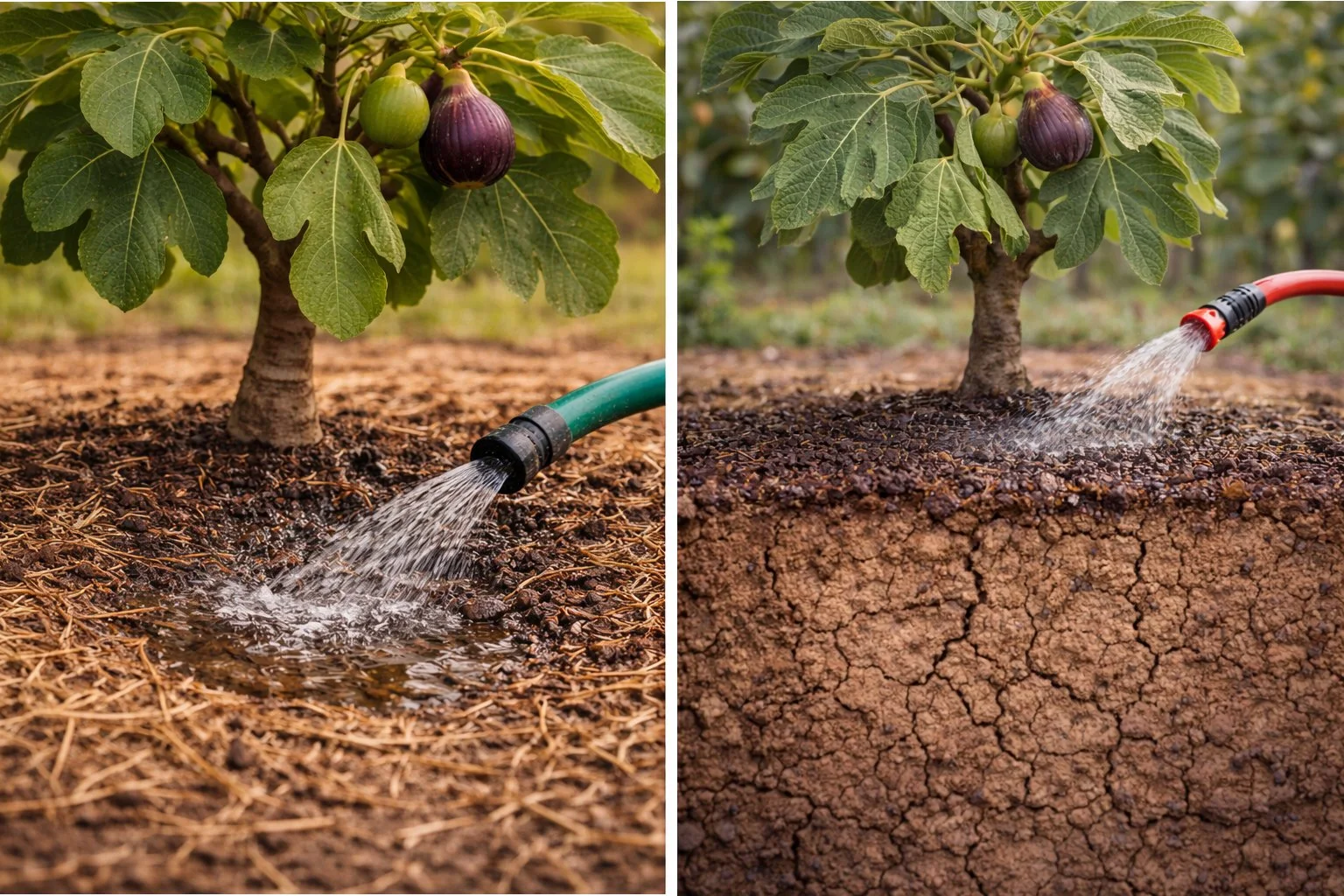
How water is delivered to a fig tree matters just as much as how often it is applied. Deep watering and shallow watering create very different root environments, and over time those differences shape tree stability, drought tolerance, and fruit quality. While both approaches introduce moisture to the soil, only one aligns consistently with how fig trees naturally grow and thrive.
Figs evolved to search for water beyond the soil surface. Their roots are adapted to follow moisture downward and outward, not to remain dependent on frequent surface wetting. Understanding this preference clarifies why deep, intentional watering outperforms shallow, habitual irrigation in most growing situations.
What Deep Watering Actually Means
Deep watering refers to applying water slowly enough, and in sufficient volume, to penetrate the full root zone. Rather than wetting only the top few inches of soil, deep watering encourages moisture to move downward where roots can access it over time. This creates a stable reservoir that supports growth between waterings.
In-ground fig trees respond especially well to this approach. When soil is allowed to absorb water deeply and then dry slightly before the next irrigation, roots are encouraged to grow downward, anchoring the tree and improving drought resistance. This pattern mirrors natural rainfall cycles rather than artificial irrigation schedules.
Why Shallow Watering Causes Problems
Shallow watering keeps moisture concentrated near the soil surface. While this may temporarily relieve wilting, it trains roots to remain shallow, where soil dries quickly and temperature fluctuates more dramatically. Over time, shallow root systems increase dependence on frequent watering and reduce resilience during heat or drought.
For fig trees, shallow watering often leads to erratic growth. Shoots may grow quickly but lack strength, and fruit development becomes sensitive to minor changes in moisture. Inconsistent surface moisture can also increase fruit splitting as figs experience rapid swings in water availability.
Root Behavior and Long-Term Stability
Root architecture develops in response to water placement. Deep watering promotes a broader, deeper root system capable of accessing moisture during dry periods. Shallow watering restricts roots to the upper soil layers, increasing vulnerability to stress and reducing nutrient uptake efficiency.
This difference becomes more apparent as fig trees mature. Trees trained on deep watering require less frequent irrigation and recover more quickly from short dry spells. Those conditioned to shallow watering often struggle when watering is delayed, even briefly.
Container-Grown Figs: A Modified Application
While the principles of deep watering still apply to container-grown figs, the execution differs. Containers limit root depth, but thorough watering that saturates the entire soil volume remains essential. Shallow splashes that wet only the surface leave much of the root mass dry and ineffective.
Deep watering in containers means watering until moisture flows freely from the drainage holes, ensuring all roots receive hydration. Allowing the container to drain fully before the next watering restores oxygen and prevents saturation.
Seasonal Considerations
Deep watering is most important during active growth and fruit development, when fig trees draw heavily on stored soil moisture. During cooler seasons or as dormancy approaches, watering depth and frequency should be reduced to avoid prolonged wetness.
Shallow watering during late summer or fall can prolong soft growth and delay natural hardening, increasing susceptibility to cold injury. Adjusting watering practices seasonally reinforces healthy growth cycles rather than disrupting them.
The Takeaway
Fig trees strongly prefer deep, intentional watering over frequent shallow irrigation. Deep watering supports strong root development, improves drought tolerance, stabilizes growth, and enhances fruit quality. While container systems require adaptation, the principle remains the same: water thoroughly, allow roots to breathe, and resist the urge to water by habit. When watering depth matches fig physiology, trees grow calmer, stronger, and more productive over time.
This article is part of the Irrigation & Water Management for Figs guide.
