Irrigation & Water Management for Figs
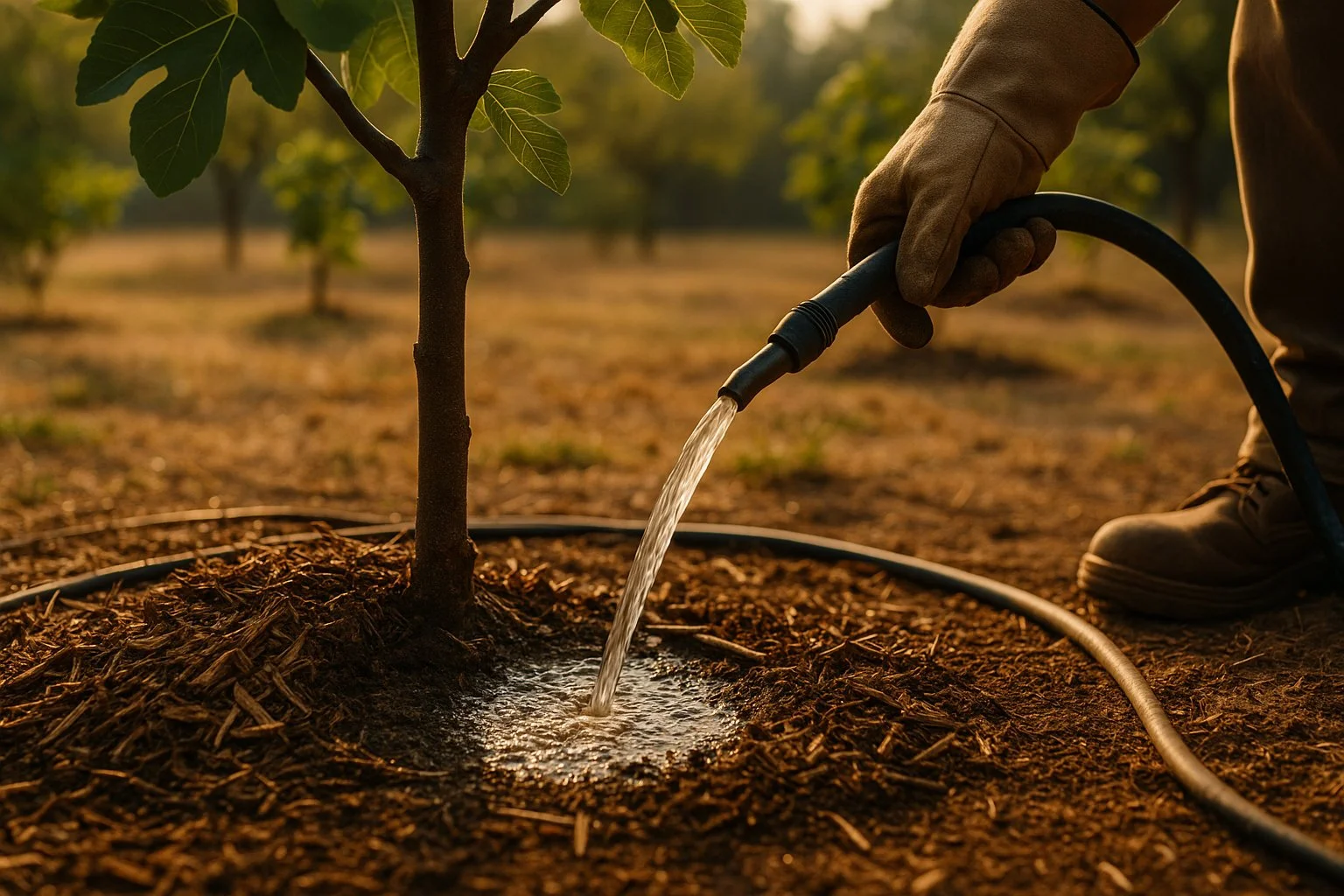
Irrigation & Water Management for Figs: Strong Roots, Consistent Growth, and High-Quality Fruit in Zone 7b
Water management is one of the most influential—and most misunderstood—factors in successful fig growing. Although figs are often described as drought tolerant, drought tolerance does not equal optimal fruiting. A fig tree that merely survives periods of dryness behaves very differently from one that receives consistent, well-timed moisture. Trees that are watered correctly grow faster, develop stronger and deeper root systems, resist splitting and souring, and produce larger, sweeter, and more uniform fruit.
In Zone 7b, where weather patterns swing between humid heat waves, sudden thunderstorms, and extended dry spells, irrigation becomes both a science and an art. This guide explains how fig trees actually use water, how soil structure influences moisture availability, and how to manage irrigation for both container-grown and in-ground figs. Once these principles are understood, water stops being a guesswork task and becomes a reliable tool for improving fruit quality and overall tree performance.
How Fig Trees Use Water
Figs evolved in Mediterranean climates characterized by cool, moist winters and long, dry summers. Their natural adaptation includes aggressive root systems capable of exploring large soil volumes in search of moisture. In cultivation—especially in containers—those roots are confined to a limited space, making water management far more critical than in the wild.
Water drives nearly every physiological process in a fig tree. It transports dissolved nutrients, maintains internal pressure that keeps leaves and shoots expanding, and directly influences how rapidly new growth develops in spring. Fruit development is particularly sensitive to moisture availability. Uneven watering often results in irregular fruit size, premature fruit drop, and splitting during ripening. Even disease resistance is influenced by hydration, as stressed tissues are more susceptible to pests and opportunistic fungi.
The objective of irrigation is not to keep soil constantly wet, but to maintain a stable moisture cycle—one that supplies roots with adequate water while preserving oxygen in the root zone.
Soil Structure and Its Role in Water Management
Effective irrigation always begins with the soil or substrate being watered. Bark-based container mixes drain rapidly and provide excellent oxygenation for roots, but they dry quickly and may require frequent watering during hot weather. In-ground soils behave differently. Many Zone 7b soils contain significant clay, which retains moisture well but can become compacted and oxygen-poor if overwatered. Sandy or heavily amended soils drain quickly and may require deeper or more frequent irrigation.
Successful water management balances two competing needs: roots require oxygen to remain healthy, yet they also require consistent moisture for nutrient uptake and sustained growth. Excess water displaces oxygen and encourages root rot, while insufficient water slows growth, reduces fruit size, and increases stress during ripening. Because soil structure determines how long water remains available to roots, soil improvement and mulching are just as important as irrigation itself.
Watering Container-Grown Fig Trees in Zone 7b
Container-grown figs experience the most extreme moisture fluctuations. During summer, bark-based substrates may dry out within a single day, especially in dark containers exposed to direct sun. Because container roots cannot access deeper moisture reserves, irrigation must be frequent, deliberate, and consistent.
In early spring, when temperatures are moderate and growth is accelerating, containers often require watering every two to three days. As summer arrives and heat intensifies, daily watering becomes common, with occasional twice-daily watering during extreme heat. In fall, as temperatures cool and growth slows, watering frequency gradually tapers.
Proper container watering involves fully saturating the root zone until water drains freely from the bottom of the pot. This practice flushes accumulated fertilizer salts and prevents chemical buildup that can damage roots and foliage. Underwatering leads to drooping leaves, reduced shoot growth, and fruit drop. Chronic overwatering creates persistently saturated conditions that encourage fungal gnats, sour-smelling soil, and root damage.
Watering In-Ground Fig Trees in Zone 7b
In-ground fig trees generally require less frequent irrigation, but consistency remains important—especially during fruit development. Young trees in their first one to two years rely on regular watering to establish a strong, permanent root framework. Deep watering during dry spells encourages roots to grow downward rather than remaining near the surface.
Mature trees become more resilient but still benefit from supplemental irrigation during extended dry periods. Water stress during fruit development often leads to fruit drop or stalled growth. A deep soaking every one to two weeks during prolonged drought supports uniform fruit sizing and improves sweetness and flavor.
Mulching is indispensable for in-ground figs. A thick layer of organic mulch reduces evaporation, moderates soil temperature, suppresses weeds, and protects roots from both summer heat and winter cold. Few water-management practices provide as much benefit with as little effort as consistent mulching.
Watering and Fruit Quality: Splitting, Souring, and Drop
Many fig fruit problems are directly linked to inconsistent water availability. Splitting commonly occurs when trees experience dryness followed by sudden heavy watering or rainfall. The fruit absorbs water faster than the skin can stretch, causing cracks. Maintaining steady moisture throughout ripening minimizes this risk.
Souring develops when excess moisture, high humidity, and open ostioles allow microorganisms and insects to enter ripening fruit. Balanced irrigation combined with good airflow and appropriate variety selection helps reduce losses.
Fruit drop is frequently a response to stress—either severe dehydration or rapid swings in water availability. When moisture remains consistent, internal hormonal signals stabilize and fruit retention improves significantly.
Irrigation Methods for Figs: Principles and Comparisons
Several irrigation approaches work well for figs, though some are better suited to Zone 7b conditions than others. Drip irrigation is widely regarded as the most efficient method for orchards, delivering water slowly and directly to the root zone while keeping foliage dry. This minimizes evaporation and reduces disease pressure.
Micro-sprayers can be useful where root zones are wide or uneven, though they increase surface moisture and humidity. Container production often benefits from controlled hand watering or bottom-watering systems that maintain consistent hydration without disturbing young roots.
The choice of irrigation method should be guided by scale, tree age, container use, soil structure, and labor availability. Each method functions best when paired with appropriate mulching and seasonal timing.
When to Water: Timing Matters
Irrigation timing influences both plant health and disease risk. Morning watering is generally ideal, as it prepares trees for rising temperatures while allowing foliage and soil surfaces to dry during the day. Afternoon watering may be necessary for containers during heat waves but is less desirable for in-ground trees. Night watering should be avoided when possible, as it promotes prolonged moisture and increases disease risk.
Seasonal Water Strategy for Zone 7b
A successful irrigation plan adapts throughout the year. In spring, steady moisture supports rapid shoot growth and canopy development. Summer brings peak water demand as fruit forms and heat stress increases. In fall, irrigation should gradually decrease to allow tissues to harden before winter. During dormancy, figs require very little water, though an occasional deep watering during extended dry spells prevents root desiccation.
Principles of Efficient Irrigation System Design for Figs
An effective irrigation system delivers water evenly, predictably, and without excess. Systems should be designed to match tree size, soil type, and planting density while allowing flexibility as trees mature. Consistent delivery, proper filtration, and pressure regulation all contribute to uniform watering and long-term reliability.
Rather than focusing on specific equipment, successful systems prioritize slow application, deep penetration, and repeatability—principles that apply whether watering a single container or an entire orchard.
Water Management and Winter Hardiness
Water availability influences winter survival more than many growers realize. Trees stressed by drought late in the growing season often enter dormancy with weaker, less lignified tissues that are more vulnerable to freeze injury. Balanced moisture through late summer supports proper hardening and improves spring recovery. Conversely, excessive late-season watering can encourage soft growth that is easily damaged by cold. The goal is generous moisture during active growth followed by a gradual reduction as temperatures decline.
