How to Identify and Remove Water Sprouts on Fig Trees
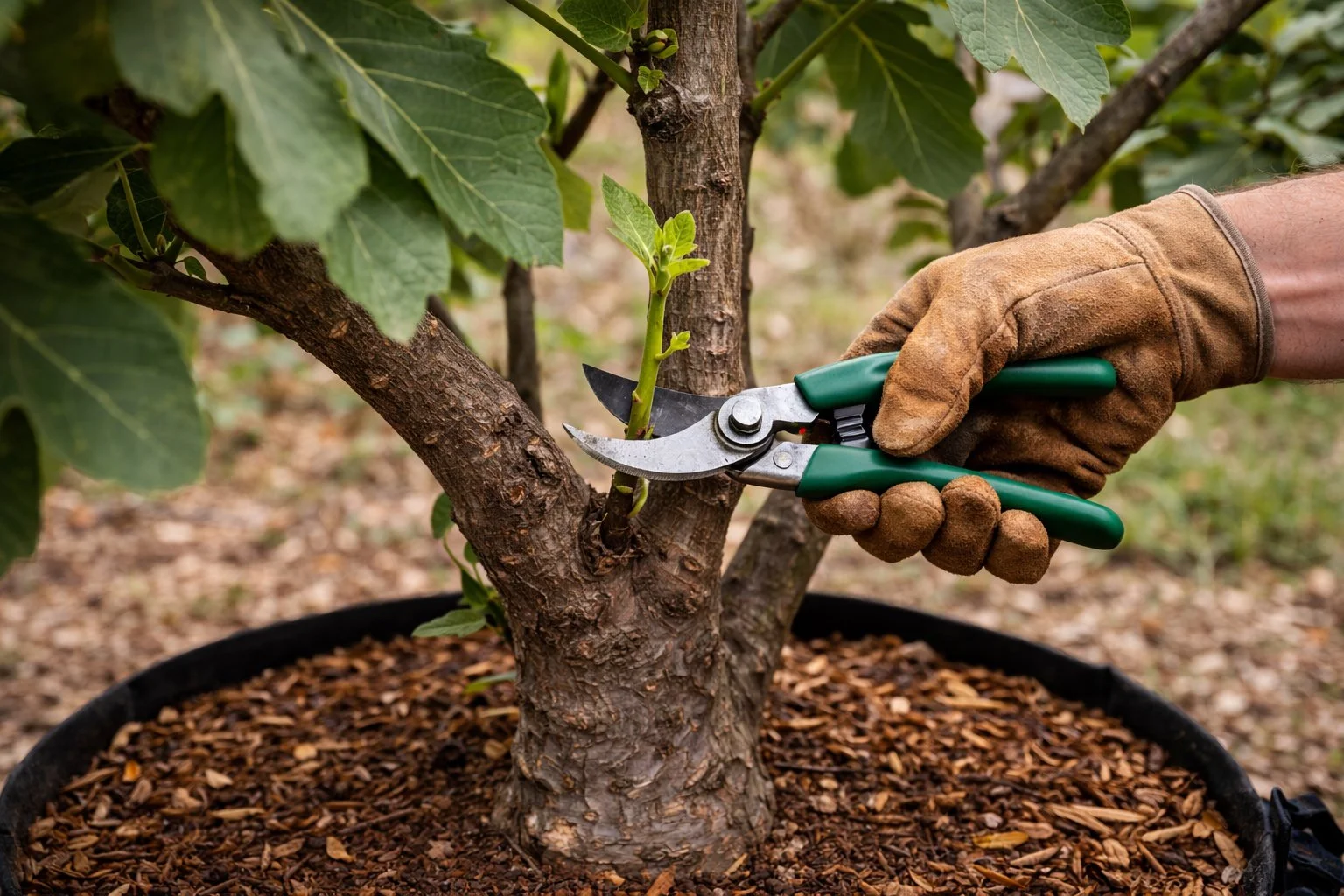
Water sprouts are one of the most misunderstood growth responses in fig trees. They often appear suddenly, grow rapidly, and give the impression of vigor and renewal. In reality, most water sprouts represent misdirected energy—growth that competes with fruiting wood, disrupts structure, and weakens long-term productivity when left unmanaged. Learning to recognize and respond to water sprouts is an essential skill for maintaining balance in both young and mature fig trees.
Water sprouts typically emerge from latent buds along trunks, main scaffolds, or heavily pruned areas. They grow straight up, with long internodes and soft, flexible wood, racing toward light rather than developing lateral strength. This growth pattern distinguishes them from productive shoots, which tend to branch outward, carry tighter node spacing, and integrate naturally into the tree’s framework. On figs, water sprouts often appear after winter damage, heavy pruning, or periods of excess nitrogen, when the tree redirects energy into rapid replacement growth.
The timing of water sprout emergence provides important clues. In spring, as sap flow resumes, the tree assesses damage and imbalance. Areas that have lost canopy or suffered injury frequently respond by pushing vigorous vertical shoots. While some of these shoots may be useful for rebuilding structure, most water sprouts grow too fast and too upright to become productive fruiting wood. Left unchecked, they shade the interior of the tree and siphon resources away from established branches.
Effective management begins with careful observation rather than immediate removal. Not every vigorous shoot is a liability. Occasionally, a water sprout emerges in a position that can replace lost scaffolding or improve canopy balance. The key is selection. Shoots that align with the tree’s intended form—angled outward, spaced appropriately, and capable of being trained—may be preserved and guided. The rest should be removed early, before they harden and claim unnecessary resources.
Timing removal correctly makes the process easier and less disruptive. Young water sprouts can often be rubbed off by hand or removed with a clean cut during early growth, minimizing stress and regrowth response. Waiting too long allows the shoot to thicken, increasing the wound size and stimulating additional replacement growth. Summer removal is often ideal, as it reduces the tree’s tendency to respond with renewed vigor compared to dormant-season cutting.
The manner of removal matters as much as timing. Cuts should be made flush to the branch or trunk without leaving stubs, which can invite decay or repeated sprouting. Clean, decisive cuts heal more predictably and send a clear signal to the tree. Avoid removing too many water sprouts at once, especially after severe winter damage, as this can destabilize the tree’s recovery. Gradual correction preserves balance while guiding growth back into productive channels.
Environmental and nutritional factors also influence water sprout formation. Excess nitrogen encourages rapid, vertical growth at the expense of structure and fruiting. Trees that are overfed or watered aggressively often produce more water sprouts than those managed with restraint. Adjusting fertilization and irrigation practices can significantly reduce the frequency and intensity of unwanted shoots, making pruning easier and more effective over time.
In container-grown figs, water sprouts are especially disruptive. Limited root volume amplifies the impact of unproductive growth, quickly throwing the tree out of balance. Prompt identification and removal keep container figs compact, stable, and focused on fruit production rather than vertical escape. In orchard settings, consistent water sprout management preserves airflow and light penetration, reducing disease pressure and improving fruit quality.
Water sprouts are not a sign of failure; they are a message. They indicate where the tree is out of balance or responding to stress. When interpreted correctly, they guide the grower toward better structure, timing, and care. Removing them thoughtfully transforms chaotic growth into intentional form, reinforcing the fig tree’s natural productivity and ensuring that energy is spent where it matters most—on healthy wood, balanced growth, and reliable fruit.
For a complete, season-by-season approach to shaping healthy, productive fig trees, see Pruning & Training for Structure and Yield.
