Fig Tree Spacing: Yield vs Manageability
Introduction
Fig tree spacing is one of the most debated orchard decisions because it forces growers to balance two competing goals: maximizing yield per acre and maintaining long-term manageability. Closer spacing can deliver impressive early production, but it often increases labor, pruning intensity, and disease pressure as trees mature. Wider spacing simplifies management and improves tree health, but may feel inefficient in the early years. Understanding how spacing choices affect both yield and workload over time allows growers to design orchards that perform well now and remain sustainable decades later.
Why Spacing Is Not Just a Measurement
Spacing is a system decision, not a number on a tape measure. It determines how sunlight reaches the canopy, how air moves through the orchard, how roots compete for water and nutrients, and how easily growers can prune, protect, and harvest trees. Poor spacing choices cannot be fully corrected later without removing trees or radically changing training systems.
In Zone 7b, spacing must also account for winter protection needs, which place additional constraints on canopy width and row access.
Early Yield vs Long-Term Performance
Tight spacing often produces higher yields in the first few years. Young fig trees remain compact, light penetration is adequate, and fruiting appears efficient. However, as trees mature, canopies begin to overlap, airflow declines, and shading increases. Without aggressive annual pruning, fruit quality and consistency suffer.
Wider spacing may appear wasteful initially, but it allows trees to reach stable production with less corrective pruning. Over time, total usable yield often equals—or exceeds—that of crowded orchards due to healthier trees and more consistent fruiting.
How Spacing Affects Tree Health
Crowded trees experience greater humidity within the canopy, slower drying after rain, and increased leaf disease pressure. Roots compete more intensely for moisture and nutrients, leading to uneven growth and stress during drought or heat waves. These stresses compound in Zone 7b, where humidity and variable weather already challenge orchard balance.
Adequate spacing reduces competition and supports natural resilience.
Spacing and Pruning Intensity
Closer spacing requires disciplined pruning to maintain light penetration and access. This increases labor demands and raises the risk of pruning errors that reduce yield. Wider spacing allows for gentler, more forgiving pruning routines and greater flexibility in training style.
Growers should choose spacing based on the level of pruning intensity they are willing to maintain year after year—not just during the orchard’s establishment phase.
Common Spacing Ranges in Zone 7b
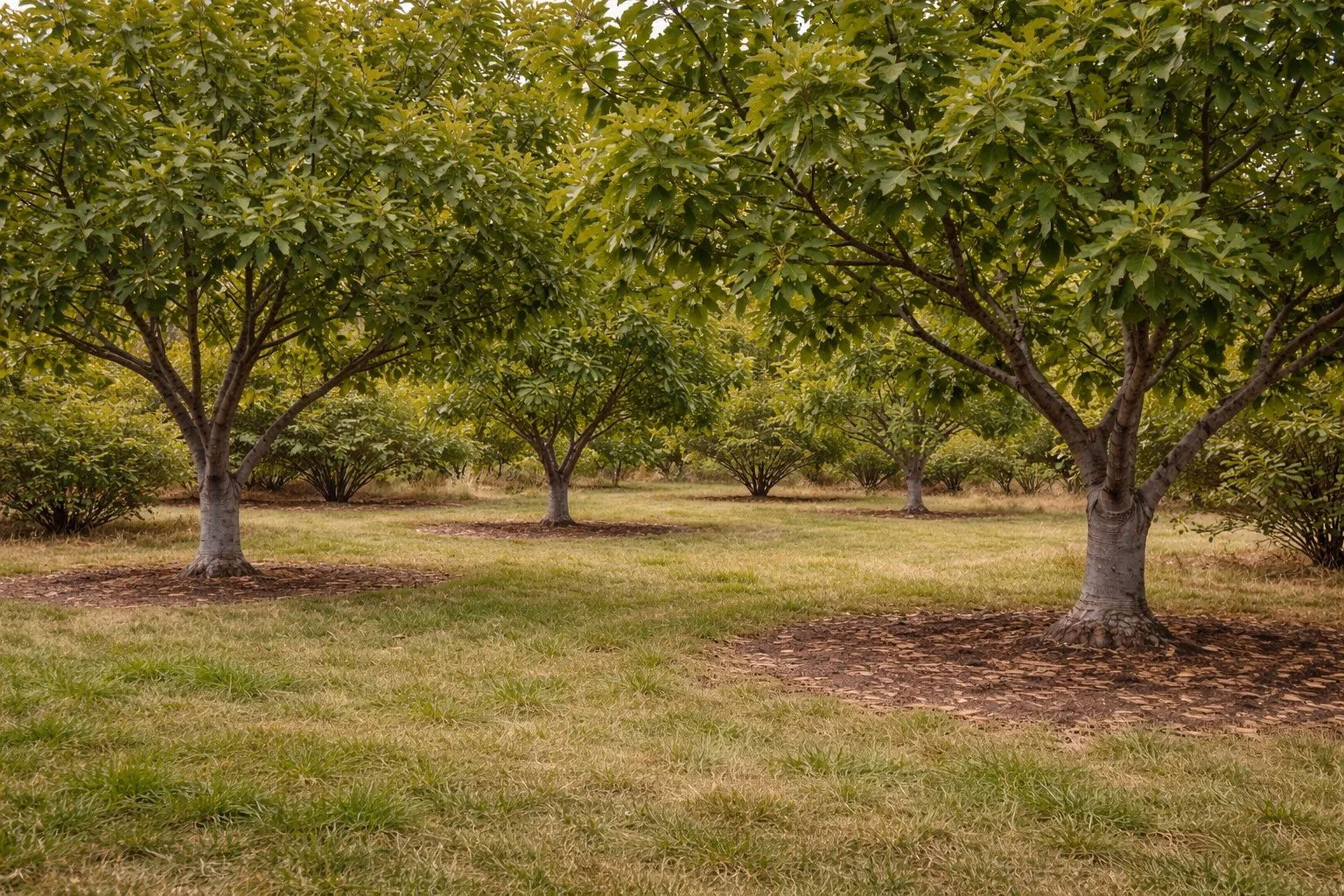
For bush-form figs, which are common in Zone 7b due to winter protection considerations, spacing of 8–10 feet between trees balances productivity and manageability. Single-trunk or open-center forms generally require 12–15 feet. High-density systems may use 6–8 feet but demand strict pruning and attentive management.
Row spacing typically ranges from 10–12 feet to allow access, airflow, and winter protection structures.
Yield per Tree vs Yield per Area
Tighter spacing increases yield per area early but reduces yield per tree over time. Wider spacing increases yield per tree and stabilizes production. Growers should consider which metric matters more for their goals: short-term volume or long-term consistency.
For small orchards and homesteads, ease of management often outweighs maximum density.
Spacing and Winter Protection Compatibility
In Zone 7b, spacing must allow room for wraps, cages, or low tunnels. Crowded trees complicate winter protection and increase labor. Consistent spacing simplifies protection systems and reduces damage during installation and removal.
Spacing decisions that ignore winter realities often create the most frustration later.
Adjusting Spacing Through Training
Training systems can partially compensate for spacing limitations. Height control, branch selection, and canopy shaping allow trees to coexist more closely. However, training is a management commitment. Spacing should support the chosen training system, not rely on it to solve design flaws.
Avoiding the Most Common Spacing Mistakes
Common mistakes include planting too close “just in case,” underestimating mature canopy width, and copying spacing from other fruit crops without considering fig growth habit. Another frequent error is spacing trees tightly without planning for winter protection or access lanes.
Field Observations — Giles County, Tennessee (Zone 7b)
Spacing considerations discussed in this article are based on in-ground orchard establishment in Pulaski, Tennessee, USDA Zone 7b. Tree placement decisions are evaluated within the context of winter dieback risk, structural regrowth patterns, airflow management in humid summer conditions, and long-term canopy manageability rather than maximum theoretical yield.
In cold-edge climates such as Zone 7b, fig trees frequently regenerate from partially damaged upper structure. Spacing must therefore allow for multi-stem regrowth, variable height recovery, and seasonal structural correction without overcrowding. Observations across early establishment seasons emphasize that slightly wider spacing improves airflow, simplifies winter protection strategy, and supports sustainable maintenance as trees mature.
These recommendations reflect field performance under southeastern growing conditions rather than Mediterranean production models.
The Takeaway
Fig tree spacing is a long-term decision that shapes yield, labor, and orchard health. By balancing early productivity with future manageability—and by accounting for pruning intensity, winter protection, and access—growers create orchards that remain productive and enjoyable to manage for decades.
This article is part of the complete guide to Fig Orchard Design & Spacing.
Related reading:
Choosing the Right Site for a Fig Orchard
Row Orientation, Sun Exposure, and Airflow
Designing for Equipment, Access, and Maintenance
