How to Identify Nutrient Deficiencies in Fig Trees
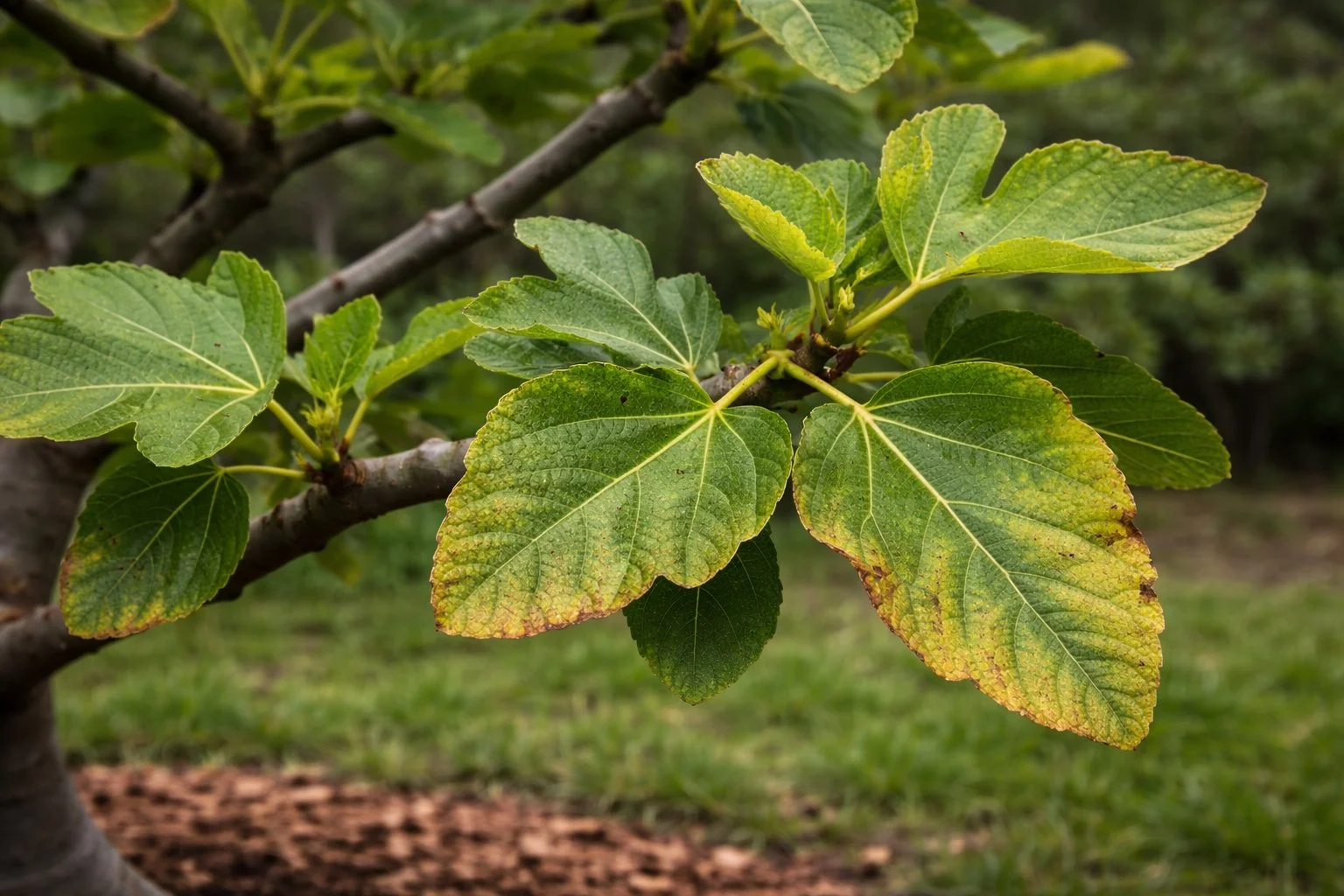
Nutrient deficiencies in fig trees rarely appear suddenly. They develop gradually as growth patterns shift, leaves change color or size, and overall vigor declines. Because figs tolerate a wide range of conditions, deficiencies are often subtle and easy to misinterpret, especially when water stress or seasonal changes are involved.
Learning to recognize nutrient-related signals helps growers respond calmly and accurately instead of guessing or overcorrecting.
Why Deficiencies Are Often Misdiagnosed
Many symptoms associated with nutrient deficiencies resemble other stresses. Yellowing leaves may point to nitrogen shortage, but they can also result from overwatering, root stress, or natural aging. Stunted growth might reflect poor nutrition, but it can just as easily follow cold damage or compacted soil.
For this reason, deficiency diagnosis should always consider growth context, timing, and overall plant behavior rather than relying on color alone.
Nitrogen Deficiency: Slow Growth and Pale Foliage
Nitrogen deficiency in figs typically presents as reduced vigor rather than dramatic discoloration. Leaves may appear smaller than normal and lighter green, especially on older growth. Shoot extension slows, and the canopy may look sparse or underdeveloped during the active growing season.
Unlike overfertilization, nitrogen deficiency does not usually produce distorted growth. Instead, everything appears restrained. In containers or sandy soils, nitrogen deficiency is more likely because nutrients leach quickly.
Potassium Deficiency: Weak Structure and Stress Sensitivity
Potassium deficiency often shows up indirectly. Leaves may develop marginal browning or scorching, particularly during hot or dry periods. Stems can appear weaker, and fruit quality may decline even when growth seems adequate.
Figs lacking potassium often struggle during stress events. Heat, drought, or pruning stress triggers symptoms more readily than in well-balanced trees. This makes potassium deficiency easy to miss until conditions become challenging.
Phosphorus Deficiency: Subtle and Uncommon
Phosphorus deficiency is relatively rare in established fig trees but may appear in very poor soils or containers with exhausted media. Growth may be slow, roots underdeveloped, and recovery after planting or stress delayed.
Because phosphorus does not cause obvious leaf discoloration in figs, it is often overlooked. Weak establishment or poor response to otherwise good care can be a clue.
Micronutrient Issues: Less Common, Still Possible
Micronutrient deficiencies are uncommon but can occur in containers or soils with extreme pH. Iron deficiency may cause yellowing between leaf veins on new growth, while magnesium deficiency can appear as interveinal yellowing on older leaves.
These issues tend to appear patchy rather than uniform across the tree. When suspected, correcting soil conditions is usually more effective than adding targeted supplements.
Timing Matters in Diagnosis
The time of year matters when interpreting symptoms. Early-season pale growth may simply reflect cool soil temperatures. Late-season yellowing can be normal as figs prepare for dormancy. Deficiencies are most meaningful when symptoms persist during active growth under otherwise favorable conditions.
Quick reactions early in the season often do more harm than good.
Before Reaching for Fertilizer
Before assuming deficiency, consider recent fertilization, watering patterns, and root conditions. Excess nutrients can block uptake just as effectively as shortages. Poor drainage, compacted soil, or root damage frequently mimic deficiency symptoms.
In many cases, improving soil conditions or correcting water management resolves symptoms without additional feeding.
The Takeaway
Nutrient deficiencies in fig trees reveal themselves through changes in growth behavior more than dramatic visual signals. Slow growth, weak structure, and stress sensitivity often tell a clearer story than leaf color alone. Careful observation, patience, and context-driven decisions prevent unnecessary fertilization and support long-term tree health.
For a complete, season-by-season guide to feeding fig trees correctly, see our full fertilization guide here.
