Soil Preparation Before Planting Figs
Introduction
Soil preparation sets the ceiling for fig orchard success. While figs tolerate a wide range of soils, their long-term vigor, fruit quality, and winter resilience depend heavily on how the soil is prepared before planting. In Zone 7b, where heavy clay, seasonal saturation, and freeze–thaw cycles are common, thoughtful soil preparation reduces stress on trees and prevents problems that are difficult—or impossible—to correct later.
This article focuses on preparing soil as a system, not a single amendment, ensuring that fig trees establish quickly and perform consistently for decades.
Why Pre-Plant Soil Work Matters
Once fig trees are planted, soil structure changes slowly. Compaction, drainage limitations, and poor root-zone conditions persist for years. Pre-plant preparation creates an environment where roots can expand freely, access oxygen, and buffer environmental extremes. Healthy soil reduces irrigation demand, stabilizes growth, and improves winter survival—critical outcomes in Zone 7b.
Assessing Drainage Before Planting
Drainage is the first priority. Figs fail in soils that remain saturated after rainfall. Before planting, observe how water behaves across the site during heavy rain. Areas that puddle, remain muddy, or smell anaerobic are unsuitable without modification.
Simple test holes reveal drainage quality. If water remains in a hole for more than 24 hours, corrective steps—such as mounding or raised rows—are required.
Managing Clay-Dominant Soils
Many Zone 7b orchards sit on clay-heavy soils. Clay is not inherently bad; it holds nutrients and moisture well. The problem arises when clay becomes compacted or saturated. The solution is structure, not sand.
Incorporating organic matter improves aggregation, increases pore space, and enhances oxygen availability. Raised planting areas lift roots above saturated zones and dramatically improve performance.
Soil Depth and Rooting Space
Figs develop extensive root systems when allowed. Shallow soils over bedrock or hardpan restrict root growth and increase drought and cold stress. Digging multiple test holes across the orchard identifies depth limitations and informs spacing and planting strategy.
Where depth is limited, wider spacing and mounding help compensate by expanding the effective root zone.
Correcting Compaction
Compacted soils restrict root growth and water movement. Compaction often results from equipment traffic, previous pasture use, or construction. Deep loosening—through mechanical subsoiling or broadforking—can restore structure if done before planting.
Once trees are established, correcting compaction becomes far more difficult.
Organic Matter as a Structural Tool
Organic matter is the foundation of healthy fig soil. Compost, leaf mold, aged wood chips, and decomposed manures improve water infiltration, nutrient availability, and microbial activity. The goal is not fertility alone, but resilience.
Organic inputs should be incorporated broadly across planting rows rather than concentrated in individual holes, encouraging roots to explore outward.
Avoiding the “Amended Hole” Problem
Over-amending individual planting holes creates a “pot effect,” where roots circle within the enriched zone rather than expanding into native soil. This limits anchorage and long-term resilience. Soil improvements should extend across the row or planting area to promote uniform root development.
Soil pH and Nutrient Balance
Figs prefer slightly acidic to neutral soil but tolerate a wide range. Extreme pH values should be corrected before planting. Soil testing provides guidance, but moderation matters—dramatic corrections are rarely necessary.
Balanced nutrition supports steady growth and improves fruit quality, but excess fertility encourages vegetative growth at the expense of structure and winter hardiness.
Preparing Raised Rows and Mounds
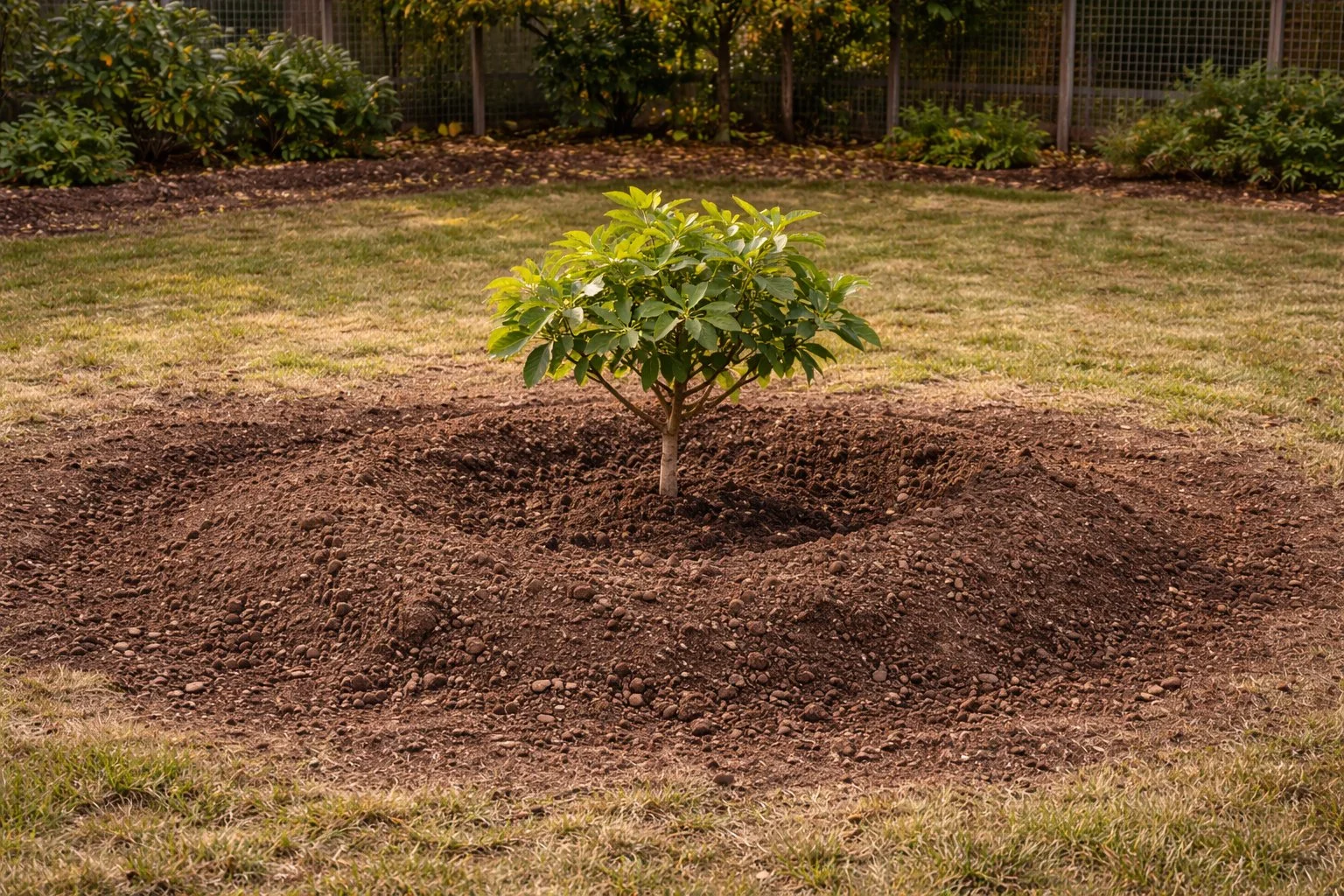
Raised rows are one of the most effective soil strategies in Zone 7b. Elevating the root zone improves drainage, warms soil earlier in spring, and simplifies winter protection installation. Rows should be wide enough to support mature root systems and mulched heavily after planting.
Timing Soil Preparation
Soil preparation is best completed months before planting. This allows amendments to integrate, soil structure to settle, and microbial activity to stabilize. Rushed preparation often leads to uneven settling, water pooling, and root stress.
The Takeaway
Soil preparation is not glamorous, but it is decisive. By prioritizing drainage, structure, depth, and organic matter before planting, growers create fig orchards that grow vigorously, resist stress, and remain productive for decades. Good soil makes every other orchard decision easier.
This article is part of the complete guide to Fig Orchard Design & Spacing.
Related reading:
Choosing the Right Site for a Fig Orchard
Intercropping or Underplanting with Figs
Designing for Equipment, Access, and Maintenance
