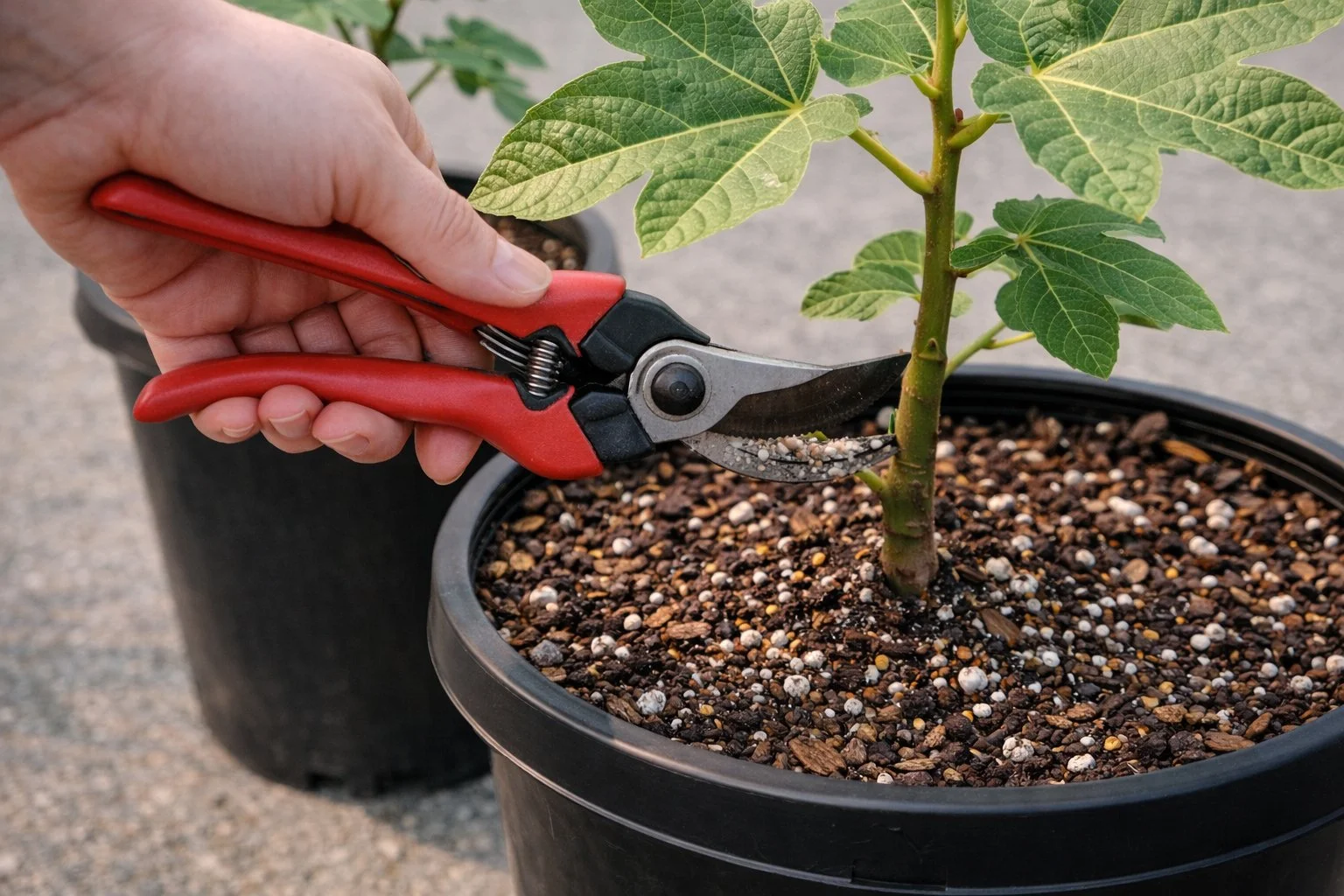
Pruning serves a different purpose in containers than it does in the ground. While in-ground figs often require pruning to correct excess vigor or storm damage, container-grown figs rely on pruning as a primary tool for maintaining balance. Size control, fruiting consistency, and long-term health are all shaped by how and when cuts are made.
In a container, space is finite. Pruning is not about forcing productivity but about aligning the tree’s structure with the limits of its root system.
Why Containers Change Pruning Priorities
Container-grown figs experience natural root restriction, which already moderates growth to some extent. Pruning in this context is less aggressive and more intentional. The goal is to guide the tree into a stable form that can support fruiting wood without constant correction.
Unchecked growth in a container often leads to tall, top-heavy trees that dry out quickly, tip over easily, and allocate energy inefficiently. Pruning restores proportionality between roots and shoots, helping the tree function as a coherent system rather than a collection of competing branches.
Establishing a Manageable Framework Early
Early pruning decisions have lasting consequences in containers. Establishing a low, well-spaced framework allows light to reach fruiting wood and keeps the tree accessible for care and harvest. Whether trained as a compact bush or a short single-stem form, container figs benefit from clear structure rather than dense interior growth.
Once the basic framework is set, pruning becomes maintenance rather than correction. This reduces stress on the tree and minimizes large cuts that can delay fruiting.
Balancing Vegetative Growth and Fruiting Wood
Figs fruit on current-season growth that arises from established wood. In containers, excessive vegetative growth often comes at the expense of fruit development. Strategic pruning helps regulate this balance by limiting overly vigorous shoots while preserving productive branches.
Removing weak, shaded, or crossing growth improves airflow and directs energy toward shoots capable of supporting fruit. Pruning is not about reducing the number of branches indiscriminately, but about choosing which branches deserve the tree’s resources.
Height Control and Practical Limits
One of the advantages of container growing is the ability to define a practical height limit. Tall container figs are harder to water evenly, more prone to wind stress, and less efficient in fruit ripening. Regular heading cuts during the dormant season keep height within manageable bounds.
Maintaining a consistent height also simplifies seasonal movement for winter protection. Trees that fit comfortably through doorways or under covers are easier to manage year after year.
Root Pruning as a Complementary Tool
Over time, even well-sized containers become crowded with roots. When top growth begins to slow despite proper care, root congestion may be the limiting factor. Root pruning during dormancy refreshes the root system and restores balance between roots and canopy.
Root pruning should be approached deliberately, removing only a portion of the outer root mass and replacing exhausted soil with fresh mix. When combined with moderate top pruning, this practice extends the productive life of container figs without increasing container size.
Seasonal Timing and Recovery
Dormant-season pruning sets structure and controls size, while in-season adjustments are best kept minimal. Heavy summer pruning can stimulate unwanted vegetative growth and disrupt fruit development. When corrective cuts are needed during the growing season, they should be limited and purposeful.
Container figs generally recover quickly from well-timed pruning, especially when water and nutrition are managed consistently. Stress arises not from pruning itself, but from pruning that ignores the tree’s growth stage and environment.
Pruning as Ongoing Stewardship
Pruning container figs is an exercise in observation and restraint. Each cut should serve a clear purpose, reinforcing structure, improving light distribution, or preserving balance. Over time, this approach produces trees that are easier to manage, more resilient to stress, and more reliable in fruiting.
Rather than forcing container figs to behave like in-ground trees, effective pruning respects the constraints of the container and works within them.
For a complete, season-by-season framework that ties soil, watering, pruning, winter protection, and variety choice together, see Growing Fig Trees in Containers.
