Winter Protection & Dieback Prevention for Fig Trees in Zone 7b
Winter protection is the single biggest factor separating fig trees that merely survive from those that fruit reliably in Zone 7b. Cold injury, fluctuating temperatures, and winter moisture all shape how much living wood a fig carries into spring—and that, more than variety alone, determines harvest timing and yield. Understanding why fig trees experience dieback, when protection actually helps, and how different methods affect recovery allows growers to make deliberate decisions rather than reacting after damage has already occurred.
This guide provides the framework for protecting fig trees through winter and managing dieback intelligently. It explains how figs respond to cold, how to evaluate damage in spring, and how protection strategies vary based on tree age, structure, and winter severity. The detailed methods and scenarios are explored in the supporting articles that follow.
How to Preserve 3–4 Feet of Fig Growth Each Winter in Zone 7b Using Proven Microclimate, Structural, and Covering Techniques
Winter protection is the defining challenge of fig growing in Zone 7b. While figs can technically survive temperatures in the teens, simple survival is not enough. A fig tree that lives through winter but dies back to the ground behaves less like a fruit tree and more like a perennial shrub. It must rebuild its framework each spring, grow new fruiting wood, and attempt to ripen a crop before fall arrives—a cycle that shortens the harvest window, delays ripening, and dramatically reduces yield. The difference between “a fig tree that lives” and “a fig tree that produces” lies entirely in your winter protection strategy.
At Giles County Figs, your specialty is preserving three to four feet of branch growth through winter. This retained wood allows trees to leaf out early, set fruit sooner, and consistently produce well before the late-summer heat peaks. The system works because it focuses on understanding why figs suffer winter injury, how cold interacts with fig physiology, and what practical methods can reliably prevent dieback in Zone 7b.
1. Why Figs Suffer Dieback in Zone 7b
Fig wood is soft and water-rich, which makes it more vulnerable to cold injury than the wood of most temperate fruit trees. When temperatures fall below roughly 15–17°F—especially when cold lasts for several hours—the cambium layer can rupture. The newest, least lignified wood is typically the first to be damaged, and injury progresses downward as temperatures drop. Sudden early freezes before the tree has hardened off, prolonged cold periods below 10°F, mid-winter warm spells that cause premature sap movement, and tall unprotected scaffolds exposed to wind all contribute to dieback. Even fall nutrition plays a role; trees with late-season nitrogen are far more susceptible because they carry soft, green growth into winter.
Understanding these influences is the foundation of every successful protection system.
2. The Goal: Preserve Last Year’s Wood
Figs fruit on both last year’s wood (the breba crop) and the current season’s new shoots (the main crop). When winter kills all of last year’s growth, the breba crop disappears and the main crop begins weeks later—often pushing ripening into the edge of fall. By contrast, preserving three to four feet of wood each winter creates immediate advantages: the tree leafs out earlier, initiates fruit sooner, extends its harvest window, and produces significantly higher yields. Consistent protection transforms a marginal Zone 7b fig tree into a productive, orchard-stable fruit tree.
3. Preparing the Tree for Winter (September–November)
Effective protection begins long before freezing weather. As fall arrives, reducing nitrogen allows the tree to shift from growth mode to hardening mode. Balanced watering helps the tree resist cold injury; both drought and saturation increase winter vulnerability. Potassium-forward nutrition strengthens cell walls, while mulch stabilizes soil temperature and prevents freeze-thaw cycles around the root zone. Removing soft, late-season shoots that will never lignify helps ensure that only strong, mature wood enters winter. A tree prepared in this way withstands low temperatures far better than a tree still pushing tender growth into November.
This approach is part of our Zone 7b orchard trial framework.
4. Passive Protection Through Microclimates
Before wrapping, bending, or tunneling a single tree, it’s useful to understand how much protection can be gained simply by choosing the right location. South-facing slopes store heat, while south-facing walls reflect warmth and reduce wind exposure. Areas protected by hedges, evergreen windbreaks, or structures experience far less evaporative freezing. Mulch moderates soil temperature and reduces root exposure to cold. Even without physical coverings, a fig planted in a well-chosen microclimate can tolerate substantially harsher winter conditions than one planted in an exposed field.
5. Physical Protection Methods That Work in Zone 7b
Zone 7b requires more than passive protection for consistent, reliable fruiting. Several physical protection methods have proven dependable, but only a few consistently preserve multiple feet of wood across variable winters. These are the techniques used by growers who expect stable production every year.
Simple Wraps
For mild winters, breathable wraps of burlap, blankets, or frost cloth around tied-up branches offer moderate protection. Although this approach won’t fully safeguard wood during severe cold snaps, it meaningfully reduces injury in winters that remain above the low teens.
Insulated Column Wraps
A more reliable system involves gathering branches into a vertical column, wrapping them with insulating fabric, adding a waterproof outer layer with ventilation gaps, and mulching the base heavily. This “middle tier” strategy is popular because it can preserve two to four feet of wood in a typical Zone 7b winter without requiring complex structures.
Low Tunnels Over a Pruned Framework
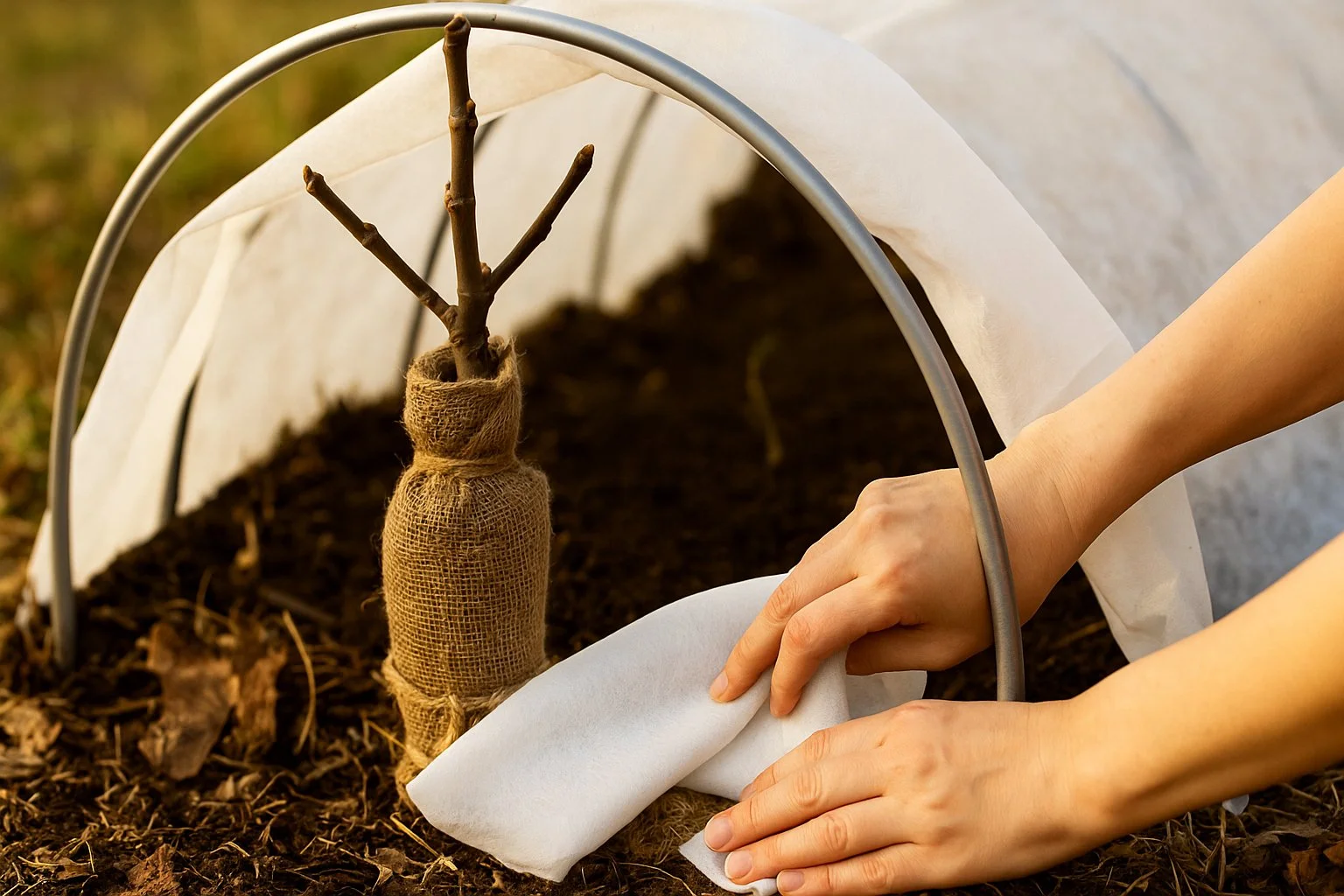
This is the heart of your specialty and the most practical method for orchard-scale winter protection in Zone 7b. Trees are pruned in late fall to a consistent low framework—usually about three to four feet. Metal or PVC hoops are installed over the row, and the structure is covered with greenhouse plastic or heavy frost cloth. Insulation such as leaves, straw, or foam board is added along the sides, and a small amount of supplemental heat can be applied during extreme cold events. The method works because the tunnel traps ground heat, eliminates wind exposure, and standardizes the height of protection. With this system, an orchard of twenty to fifty trees can be protected quickly and uniformly.
Complete Enclosures
Some commercial growers use temporary poly enclosures or mini greenhouses to eliminate winter injury entirely. By maintaining temperatures ten degrees above outside lows and venting during warm spells, the grower can ensure that all scaffolds survive winter. While highly effective, this method requires more infrastructure and is best suited for high-value collections or commercial-scale orchards.
6. Root Protection: A Critical but Overlooked Element
Winter dieback is not limited to branches. The fine feeder roots that support spring growth are extremely sensitive to cold soil. Heavy mulch, leaf litter, and straw insulate the root zone and prevent freeze-thaw cycles that damage young roots. Avoiding late-season nitrogen encourages the roots to harden, while slightly reducing irrigation in late fall helps them transition into dormancy. A warm, protected root system produces vigorous spring growth even when some branch tips are lost.
7. Recovery and Corrective Pruning After a Hard Winter
Even well-protected figs may experience some injury during unusually severe winters. Recovery begins with pruning back to living wood as soon as spring growth begins. Soft, hollow, or water-soaked stems should be removed immediately. The strongest regrowth should be chosen to maintain your original structure, preventing the tree from turning into a thicket of weak stems. Light feeding once growth resumes helps the tree rebuild vigor. With a disciplined approach, even a moderately damaged tree can return to full productivity within a single season.
8. Cultivar Differences in Cold Hardiness
Cold tolerance varies dramatically between fig varieties. In Zone 7b, cultivars like Celeste, Brown Turkey, Hardy Chicago types, the LSU series, and Mt. Etna types regularly outperform more sensitive Mediterranean cultivars. Honey figs, Adriatics, and larger-fruited varieties perform acceptably with protection, while high-sugar types such as the Col de Dame and Preto families require aggressive winter systems to thrive. Matching your protection intensity to the cultivar ensures predictable results.
9. The Annual Winterization Calendar for Zone 7b
A clear seasonal plan removes guesswork. In September and October, nitrogen is reduced and the hardening phase begins. November focuses on mulch, light pruning, and preparing structures for wraps or tunnels. Full protection is installed in December before the first deep freeze. January and February require monitoring for extreme cold and adding supplemental heat if needed. In March, coverings are gradually removed to avoid shocking tender buds, and April brings corrective pruning and the first feeding of the season. This system keeps trees on a predictable schedule and ensures reliable performance year after year.
10. The Future of Winter Protection: Low Tunnels + Insulation + Backup Heat
This approach combines low-height training with rigid or semi-rigid tunnels, perimeter insulation, heat retention strategies, and small emergency heaters that raise internal temperature by five to ten degrees. This integrated method allows Zone 7b growers to achieve results similar to orchards one or two zones warmer. It opens the door to growing a wider range of cultivars, ripening fruit earlier, and producing consistently even in winters that once would have wiped out the entire season’s scaffolding.
